

Population of Bahrain by nationality
Bahrain, like many of its GCC neighbors, has a population shaped largely by labor migration — with expatriates making up over half the population and accounting for a striking 77 percent of the workforce.
Bahrain, a small island country situated near the western shores of the Persian Gulf is home to over 1,3 million people. Most of whom are expats and just like its neighbors in the GCC, the high number of expats compared to the local population presents some interesting problems.
Labor migration to Bahrain and the GCC in general is first and foremost a consequence of development, since major construction projects that many GCC countries have embarked on attract large numbers of migrant workers in order to fill the workforce demand required to complete these projects.
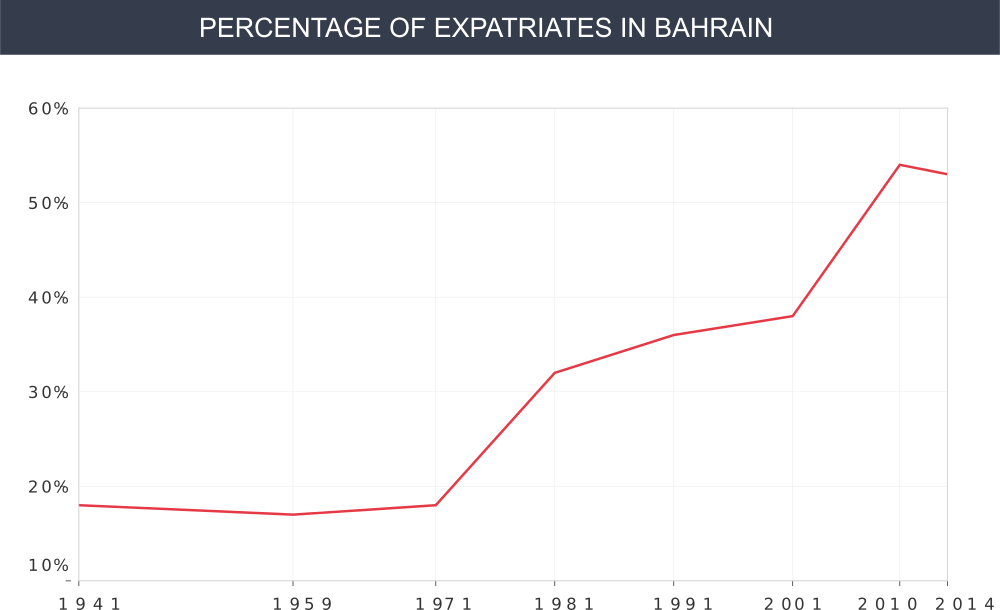
According to the Middle East Research and Information Project, when the first census was carried out in 1941, the percentage of foreigners already stood at 18 percent of the population, as migrant workforce started to enter Bahrain in 1930s with the development of the oil industry. The 1959 census provided data on employment, and at the time foreigners continued to represent about 17 percent of the population, and compared to the labor force, about one third of it.
As with many of the GCC countries, the number of expats outnumbers the local population. The population of Bahrain is around 1,317,602 and the locals make up around 48 percent of it. And like their GCC neighbors they are also dependent on them for workforce needs, with expats reported to account for 77 percent of Bahrain’s workforce.
How We Collected the Data
With the information not forthcoming from official governmental sources, we opted to replicate our models which we have used for Qatar, UAE, and Kuwait in the past. Namely, we started compiling data on the population by nationality from other available sources such as:
- Estimates provided to us by Embassies of foreign countries.
- Quotes by ambassadors previously made in other media.
- Quotes by Bahraini officials previously made in other media.
- Government of Bahrain’s official statistics reports either previously published in other media or acquired by us directly from the relevant websites.
In this fashion, we have been able to compile a list of 41 nationalities for which we were able to acquire information. It is important to note that this does not mean other nationalities are not present in Bahrain; it simply means that we did not list them due to one of the following reasons:
- Available data was more than 3 years old.
- The Embassy was not willing to share that information with us.
- The Embassy did not possess an exact number or an estimate on the population of their nationals.
- We were unable to reach the Embassy after numerous attempts.
- The publicly available data was not attributed to a legitimate source of information.
THE LIST OF NATIONALITIES
Bahrain’s population by country of origin
| Country ↕ | Population ↕ | % of Total ↕ | Data Recency ↕ |
|---|
Some nationalities do not appear on the list however, due to reasons explained above in the section on data collection. We asses nationals of the following countries might or should be present in Bahrain in bigger numbers and hopefully the data will become available in the future: Somalia, Ehtiopia, Syria, Yemen.
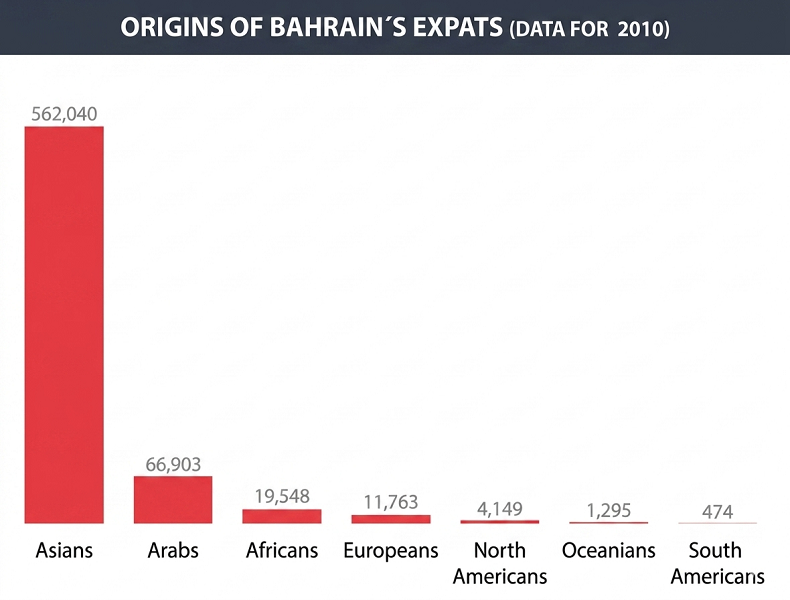
An interesting thing to note is that while there are around 2000 Palestinians in Bahrain, the contact we spoke with in the embassy did point out that there are around 5000 Palestinians who have acquired other passports. Another important thing to note is that while the number of citizens of the Philippines is 50-60 thousand, our contact told us that this would only be for skilled labor and their dependent, and that they are trying to consolidate all the numbers they have from different government bodies in order to get a more accurate figure. Unfortunately that data is still not available and will require some time before it is fully ready. The same goes for the US figures, the numbers in the table refer only to the military personnel and their families.
Countries for which we acquired the data for directly from Embassies, either by email or phone: Kazakhstan, Sweden, Uganda, Venezuela, Switzerland, Denmark, Mongolia, Ireland, Cyprus, Japan, Germany, Russia, Malaysia, Ukraine, Lebanon, Turkey, New Zealand, Iraq, Sudan, Nepal, Sri Lanka, Egypt, Pakistan, Bangladesh, India, Poland, Palestine, Libya, Iran, Jordan, Cameroon, Mongolia.
Countries for which we found data online, either from ambassadorial or Bahrani Government official quotes: South Korea, Italy, China, Tunisia, Thailand, Morocco, Saudi Arabia, USA, UK, Indonesia, India, Bahrain.
http://www.mofa.go.kr/ENG/countries/middleeast/countries/20070824/1_24452.jsp?menu=m_30_50
http://www.data.gov.bh/en/ResourceCenter
http://gulf-insider.com/india-bahrain-qa-with-h-e-dr-mohan-kumar/
http://archives.gdnonline.com/NewsDetails.aspx?date=04/07/2015&storyid=393289
http://www.stripes.com/news/americans-in-bahrain-urged-to-remain-vigilant-after-threat-on-jihadist-website-1.311355
http://riyadhconnect.com/saudis-seek-greener-pastures-in-other-gcc-countries/
http://www.namnewsnetwork.org/v3/read.php?id=Mjk3NjM4
http://www.thebigchilli.com/features/bahraini-envoy-a-master-of-multitasking
http://bna.bh/portal/en/news/659346
http://www.bahrainedb.com/en/news/press/Pages/Economic-Development-Board-Hosts-Chinese-Journalists.aspx#.Vdwl-iWqpHx
http://www.bna.bh/portal/en/news/586629
Bahrani Population: http://www.data.gov.bh/en/ResourceCenter