



Population of Kuwait by nationality
Similarly to its neighbors in the GCC, Kuwait relies heavily on its imported workforce and while the percentage of expatriates is not to the extremes of Qatar or the UAE, the country’s population is nevertheless dominated by expatriates.
With a population of 4,187,161 as of August 2015, a mere 30.9% are Kuwaiti nationals and the rest are so called expatriates, since Kuwait like other GCC countries makes it practically impossible to acquire nationality, hence all immigration to the country is “temporary”.
There has been a lot of public discussion and reports over the last few years about the country needing to drastically reduce the number of foreigners.
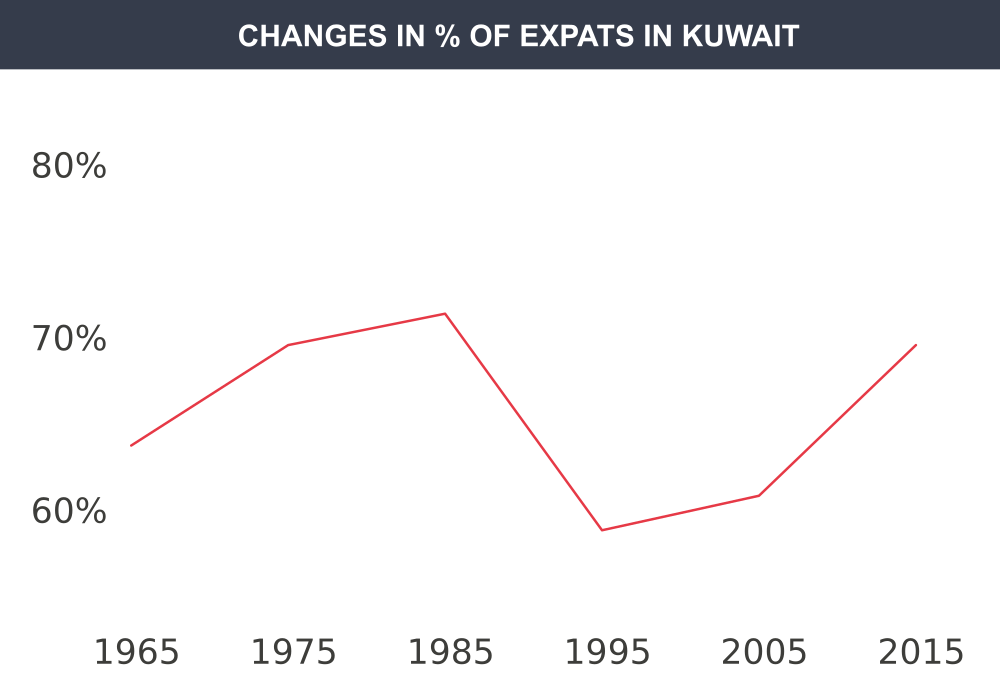
As reported by Al Rai newspaper and carried in Gulf News, Kuwaiti MPs Dr Khalil Abdullah and Abdullah Al Tamimi have urged to decrease the population of expatriates by 1.4 million in just 5 years, arguing that social and economic conditions in a country where expatriates outnumber locals by 2 to 1, are dangerous.
Thus far no such drastic measures have been taken though and as reported by Kuwait Times, the Kuwaiti cabinets in mid April 2015 seems to have opted to freeze the number of expatriates in the country instead.
Any newcomers are supposedly only going to be replacing the ones leaving the country. The measure aims to reduce the expat numbers down to 60% of the total population in the next 15 years.
The breakdown by nationality
First course of action in our pursuit of listing the population of Kuwait by nationality, was to try and get the information directly from relevant Government authorities.
However similarly to our experience with Qatar and UAE, the representative at Kuwait’s Public Authority for Civil Information told us that they only have data on the number of Kuwaitis and expats as a group, not by nationality.
With the information not forthcoming, we have opted to replicate our models which we have used for Qatar and UAE in the past. Namely we started compiling data on the population by nationality from other available sources such as:
- Estimates provided to us by Embassies of foreign countries.
- Quotes by ambassadors previously made in other media.
- Quotes by Kuwaiti officials previously made in other media.
- Government of Kuwait’s official statistics reports either previously published in other media or acquired by us directly from the relevant websites.
In this fashion we compiled a list of 53 nationalities for which we were able to acquire information. It is important to note that this does not mean other nationalities are not present in Kuwait, it simply means that we did not list them due to one of the following reasons:
- Available data was more than 3 years old.
- The Embassy was not willing to share that information with us.
- The Embassy did not posses an exact number or an estimate on the population of their nationals.
- We were unable to reach the Embassy after numerous attempts.
- The publicly available data was not attributed to a legitimate source of information.
THE LIST OF NATIONALITIES
Expatriate nationals in Kuwait by country of origin
| Country ↕ | Population ↕ | % of Total ↕ | Data Recency ↕ |
|---|
Some nationalities do not appear on the list however, due to reasons explained above in the section on data collection. We estimate nationals of the following countries might or should be present in Kuwait in bigger numbers and hopefully the data will become available in the future: Jordan, Algeria, Morocco, Somalia, Tunisia, Turkey and UK.
While Kuwait´s Public Authority for Civil Information does not publish a breakdown by nationality, it does show population of the country by broad geographical/ethnic groups, such as Arabs, Asians, Africans, North Americans, Europeans, South Americans and Australians.
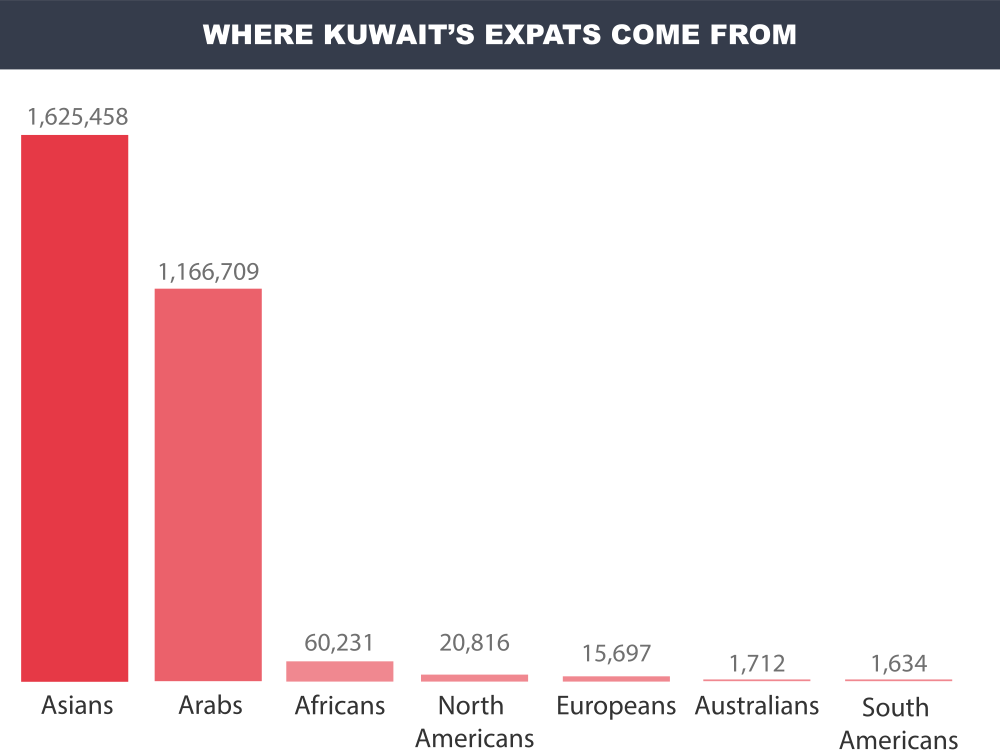
The numbers for the Asian population match our list almost to the number, however PACI´s numbers (1,166,709) for Arab expatriates substantially exceed our own findings (971,000).
As mentioned before, we haven’t been able to procure the data for the following Arab nationalities: Moroccans, Algerians, Libyans, Tunisians, Jordanians, Omanis, Bahrainis, Qataris, Emiratis and Somalis.
It could be that these nationalities when combined would amount to 195,000 however that might be questionable, as North African communities usually aren’t present in GCC countries in particularly big numbers (see populations of Qatar and UAE) and there is media coverage from 2012, which cites a report from the Government, claiming the combined numbers of Jordanians and Palestinians amount only to 53,000.
A further possibility could be that some the numbers for the Arab countries in our list above are understated. And yet another explanation could be that the statistics of some non-Arab countries were clubbed together with the Arab ones. There is also the case of stateless people or bedoon as they are called, which officially number 93,000, however some other reports put that figure somewhat higher (although not high enough to make up for the missing numbers).
The number of Africans in our list exceeds the official numbers as well, which indicates that especially the Ethiopian community appears to have reduced in size quite considerably in the last 3 years. European and North American numbers do not match exactly either, the former most likely due to us not being able to procure UK numbers and the latter might be connected to how Kuwait lists US military staff.
- Countries for which data was acquired directly from the Embassies, either by email or phone: Afghanistan, Argentina, Armenia, Australia, Brazil, Cambodia, Cyprus, Czech Republic, Eritrea, Germany, Greece, Guyana, Indonesia, Iraq, Kenya, Kyrgyzstan, Lesotho, Malaysia, Mexico, Mongolia, Myanmar, Nicaragua, Palestine, Peru, Senegal, South Korea, Spain, Sudan, Switzerland, Taiwan, Ukraine, Venezuela, Slovakia, Poland and Vietnam.
- Countries for which data was found online, either from ambassadorial or Kuwaiti Government official quotes: Bangladesh, China, Egypt, Ethiopia, Hungary, India, Iran, Lebanon, Nepal, Nigeria, North Korea, Pakistan, Philippines, Romania, South Africa, Sri Lanka, Syria, USA, Yemen and Stateless people.
- http://www.arabtimesonline.com/wp-content/uploads/pdf/2014/jul/09/06.pdf
- http://www.timeskuwait.com/Times_Kuwait-and-China-partners-in-progress
- http://www.al-monitor.com/pulse/business/2012/04/two-thirds-of-the-kuwaiti-popula.html#
- http://www.timeskuwait.com/Times_Hungary-and-Kuwait–Celebrating-50-years-of-diplomatic-friendship
- http://gulfnews.com/news/gulf/kuwait/800-000-indians-now-living-in-kuwait-1.1498483
- http://www.iran-daily.com/News/116474.html
- http://www.al-monitor.com/pulse/business/2012/04/two-thirds-of-the-kuwaiti-popula.html#
- http://www.timeskuwait.com/Times_Mission-Accomplished–H.E.-Madhuban-Prasad-Paudel–Ambassador-of-Nepal-
- http://embassyofnigeriakuwait.com/about-embassy.html
- http://www.timeskuwait.com/Times_North-Korea-
- http://www.szia.ae/news_det.php?id=1031
- http://news.kuwaittimes.net/state-filipino-community-lives-work-community-politics-pinoys-kuwait/
- http://www.timeskuwait.com/Times_Romania-—-dynamic-investment-destination
- http://www.timeskuwait.com/Times_Truly-a-South-African-gem-in-diplomacy—H-E-Delarey-Van-Tonder
- http://www.dailymirror.lk/67615/kuwait-airways-fly-daily-from-colombo
- http://www.presstv.ir/Detail/2015/01/06/391924/Syria-embassy-in-Kuwait-resumes-services
- http://news.kuwaittimes.net/heres-americans-value-kuwait/
- http://www.al-monitor.com/pulse/business/2012/04/two-thirds-of-the-kuwaiti-popula.html#
- http://www.middleeasteye.net/in-depth/features/kuwaits-stateless-offered-nationality-not-their-own-415185571
- Kuwaiti population: https://www.paci.gov.kw/Home.aspx